Escort Passport Max Review: Escort’s First Bipolar Radar Detector

Escort Passport Max

Updated: 1306Z-5, 27 DEC 13, By Veil Guy

Escort Passport Max Review: A Contradiction of the Extremes.

Developed over a five plus year period, the Escort Passport Max was billed as being the quickest, most sensitive, and most false resistant radar detector of all time–employing new technology never seen before in a consumer radar detector.

Eye catching terms–such as HD (high definition), radar DNA, advanced digital processing, NASA-based, and military-grade technology–were ascribed to the Passport Max’s new capabilities, capabilities yet to be seen in any consumer-grade radar detector.  The result was to be a radar detector possessing extreme range and quickness while being the most sophisticated at filtering out false alerts–the bane of all radar detector users.

Woah!  More than bold claims, to be sure, but quite believable at the time of the Max’s launch, as the Escort Passport Max followed hot on the heels of the release of, unarguably, the highest performing dash-mount radar detector ever produced–the revised Escort Redline Expert Edition.

I would say its launch was the most highly anticipated event of the year by the hardcore online enthusiast community in quite some time.  Not surprising, as Escort’s marketing machine was in overdrive.  The typical “authoritative” sources of early product promotion, including SML and Radar Roy, confirmed the marketing claims of Escort.  Even I got caught up in the buzz initially and penned an early Escort Passport Max preview where I explored the possibilities of such “advanced” technologies being incorporated into a radar detector.

Enthusiast forums were buzzing with the idea of a new über high-end radar detector that promised to exceed the performance of the Escort Redline while providing the advanced GPS capabilities of Escort’s Passport 9500ix and Beltronics GX65 radar detectors.  This detector was to have it all or nearly all (only lacking the RDD invisibility of the Redline).

Once again, Escort was kind enough to send me an early production model less than two weeks before the expected  launch.  SML, Radar Roy, and a couple highly respected forum members had also already gotten their hands on pre-production versions.  The early votes were in and the verdict was unanimous, this new Escort was something very special.

Being unusually short on time, I committed to spending an intense four days of multi-state long-distance testing with the hope and expectation of experiencing first hand its touted capabilities. The timing couldn’t have been better as the July 4th weekend was soon upon us.

As the weekend approached, I set off driving through PA to NJ and NY then back south to DE and returning through MD.  I hoped the roadways would be heavily enforced during the busy holiday and I wasn’t disappointed.

Over the course of four days, I experienced it all:

10.5Ghz X-band and 33.8Ghz and 34.7Ghz Ka-band in NJ
24.1Ghz K-band in Pennsylvania
34.7Ghz Ka-band and redlight camera photo enforcement in Delaware
35.5Ghz Ka-band, police laser, and 34.7Ghz K-band photo radar in Maryland

Never in such a short period did I accumulate so many encounters, including instant-on and constant-on radar.  Although I had some close calls, I emerged ticket free and had an extended and exhilarating weekend.

With all the driving, the video documentation, the near real-time posting of experiences online, I barely managed any sleep. I was entirely satisfied that I had fully profiled this detector like no other that I have profiled previously. I certainly gave it my “Max” effort and my mission was accomplished, or so I thought.

What I found was that the new Escort Passport Max was unlike any other radar detector I had previously reviewed.

So, what exactly did I find in the real-world of testing?  A contradiction of extremes.

The good stuff:

It was clear to me early on that the Passport Max was superb on X-band detection–the best I believe I’ve experienced in a windshield-mount.  Ka-reception, in general, was also exceptional often coming close and occasionally exceeding my reference Beltronics STi-R, STi-R+, and Passport 9500ci remote mount radar detectors.

Impressive stuff, to be sure.  The Passport Max was also adept at identifying photo-enforced red-light intersections successfully alerting me to their locations while driving in Delaware even though I would occasionally be alerted to its presence while driving on a highway (not uncommon with any GPS enabled radar detector).

Even more impressive was the extreme quickness of detection, something I have been a long advocate for and have only found with the top-of-the-line Whistlers, such as the Whistler Pro-78SE and Whistler XTR-695SE, band-segmented M3s (Beltronics STi-R, Beltronics STi-R plus, and Redline Expert), and the Valentine One.

Up to that point the Max had appeared to be living up to its claims.

That was until I experienced several take-aways.

The not so good stuff:

At times K-band reception was exceptional and at others it appeared to lag a bit. Sensitivity to police laser appeared to be only fair.  Most importantly, my very early production model failed, on multiple occasions, to alert to a 34.7Ghz instant-on speed trap when I made multiple runs at it.

This particular experience was quite troubling, especially given the speeds at which I often test.  Fortunately for me, my trusted reference Beltronics STi-R and Beltronics STi-R+ did their jobs at providing more than ample warning to the impending threats. I chalked this failure up as one resulting from testing an early firmware version which was promptly updated by Escort prior to shipping units to the general public.

Although Escort never fully articulated or defined the Max’s new features, I saw no evidence whatsoever of DNA or HD “technology” in play here.

What I found was a detector that was admittedly more sensitive than the Escort Passport 9500ix–the detector the Max superseded –but also somewhat less sensitive than the M3 based reference detectors.  It also appeared to be more prone to falsing than the more sensitive reference detectors, at least in my region of driving.

In fact, it was almost ridiculous how often the Passport Max falsed, certainly at a rate that was much higher than any V1 I have ever used.  To be fair, much has changed on the roads since my V1s have been relegated to my desk drawer. 

The proliferation of radar assisted lane departure and cruise control systems are wreaking havoc on the radar detector community. Not having driven with a V1 for a such a long-time, I can’t as yet comment on what the relative falsing rates would be.  That is going to have to wait until I conduct a real-world review of the latest Valentine V1C.

The bad stuff:

One of the promises made by Escort was the capability of being able to quickly sort out the bonafide radar sources (those of police speed enforcement traps) from the “noise” of other false non-threatening sources–through the use of the most advanced digital processing, all in less time than the blink of the eye.

The falsing to X-band and K-band door openers has always been tough to eliminate as they appear genuinely as weak off-axis  police radar.  Since all of the magical new DNA processing apparently wasn’t able to filter these signals out (the “noise”)–as was suggested, non-specifically, by Escort and their marketing arms–one has to rely on GPS lockout to do the trick.  A feature that has been in existence since the first Escort GPS detector appeared years ago, the Escort Passport 9500i and one feature that I am personally loathe to employ. Nothing new here, then.

Beyond the ubiquitous stationery X-band and K-band door openers–the notorious sources of all X and K falsing–the most menacing new development adversely impacting the enthusiast driver who owns a radar detector has been the explosive increase in the use of FMCW K-band radar based lane departure and cruise control systems in cars of every price point.  These obnoxious systems first started appearing on German-only imports just a few short years ago. Now they can be found in entry level Kias and GMs.

(Side note: If you ever driving your new car and find other vehicles abruptly braking for some inexplicable reason in front of you, it may be prudent for you to determine if your vehicle has one of these systems so you can promptly disable it before you rear-end someone you’ve been tailgating.   Also, be mindful of your rear-view mirror if you begin to notice chain reaction accidents that occur closely behind you.  At some point you may begin to suspect that these events have something to do your “safety-enhancing” radar polluting vehicle.)

Unlike stationery falses–which are readily identifiable by drivers–these new sources of falsing are moving and not stationery and consequently will be encountered anywhere on the road.  The fact that they are moving sources of interference eliminates the possibility of successfully using GPS lockout even if one were inclined to do so. Worse still these devices mimic the behavior of traffic enforcement radar.  Frankly, car companies and manufacturers of such systems should be ashamed of themselves for polluting the roads with these garbage signals.  But that’s another story.

Because FMCW (frequency modulated continuous wave) radar actually manifests itself differently than conventional CW (continuous-wave) radar (the type used by traffic enforcement), I couldn’t think of a more apt waveform which could (should) be potentially analyzable for its “DNA” (its makeup) and therefore be filtered out completely by the Max.

As it turned out, I was wrong.  Apparently there’s no DNA to be found there, either, although I am virtually certain it is there.  It’s just the Escort hasn’t found it yet.  In fact, I have yet to discover the DNA of any “noise” the Max can identify and “filter” out, relative to any other radar detector.

It consistently falses when in proximity to these rolling nuisances.  To its credit, it falses better than the any of the M3-based radar detectors (which alert as if they were picking up strong I/O radar).

The Max, on the other hand, presents a more constant and gentle alert that waxes and wanes gradually when one approaches and overtakes a radar-equipped vehicle.  In the event* you are overtaken by one of these vehicles, be prepared to get blasted with K-band so you won’t instinctively just hit the brakes.  It’s going to take some conditioning, I am afraid.

In fairness to the Max, these sources present falsing challenges to all radar detector manufacturers.  In my opinion, only Whistler has devised an effective solution to these systems (more on this subject when I release the review of the new Whistler CR90/CR85).

The contradictions of the extremes:

Initial presentation

When opening the box of previous top of the line models from Escort and Beltronics, you felt you were opening something special.  The carrying case and packaging material exuded quality.  Opening the Max’s packaging is somewhat anti-climactic in comparison and more typical of a conventional piece of consumer electronics.

I fondly remember the packaging of the Beltronics STi Driver. Now that was something!  But, that special something, call it mystique–the demonstrable pride a company has for its flagship product–is missing here.

Packaging

The Escort Passport Max retails at $550 and $600 (for special “limited” editions, comprised of special colored cases), amounting to $50 to $100 more than the Escort Redline Expert Edition.

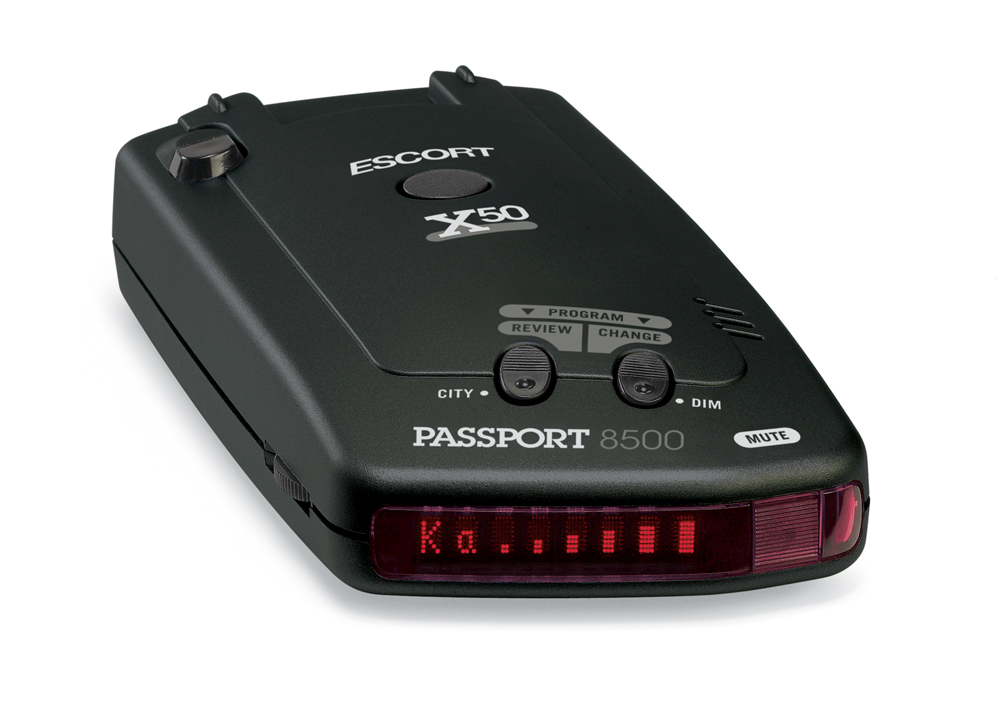
Despite the large increases in costs, the product construction and packaging appears to be a step down from the tank-like features of the Escort Redline and Beltronics STi Driver/Magnum or even the Max’s predecessors: the Escort Passport 9500ix and Escort Passport 8500 X50.

The Max is the most software driven radar detector, sporting firmware that is meant to be easily and frequently upgraded as improvements are made.  Despite this, Escort failed to provide a small USB to mini-D cable that is required for connection to a computer to perform those updates.

I am at a loss to understand how the highest priced dash-mount radar detector of all time, doesn’t come with a $0.99 cable.  Even Whistler provides a USB to mini-D cable on a their detectors that run nearly a third to a quarter of the price tag.

Display

The Max is the first dash-mount radar detector from Escort that utilizes an advanced OLED display, following in the footsteps of Cobra and Whistler.  And while the OLED displays of the Whistlers and especially Cobras are very bright, brilliantly colorful, and eminently readable in all levels of lighting conditions, the Max’s display by comparison is small, dull, dim, and virtually unreadable in most lighting conditions.

The information displayed though small and sometimes difficult to read, even at night, could be improved.  Some real-estate is wasted on the over-speed alert setting or OSP, something that I wouldn’t use anyway.  Surely something more useful could be put in its place.  If not, perhaps the information that is worth reading could be made larger instead.

Mounting Bracket

The mounting bracket is huge and looks like it belongs to a much bigger GPS system.  The new sticky cup was designed to stick to the windshield better than any other detector mount and to be a step up from the conventional two-suction-cup mounts that we typically see with radar detectors.   At first blush, this sounds most promising.  Anyone who has driven with a radar detector for any period of time, will sooner or later experience the suction cup one drop phenomenon.

Thing is, the sticky cup is not necessarily sticky at all.  It is, though, very susceptible to attracting even the slightest amounts of dust and debris when it’s not attached to the windshield.  While it appears to adhere well, initially, I have found the detector on more than one occasion resting on my dash, the following morning.  That’s a lot of weight to drop from a height and repeated impact trauma to the case and internal electronics can not be a good thing, long-term.

To maximize the sticky cup’s potential of sticking, I highly recommend washing it every time you attach it and if you elect to remove it over night, be sure to put the mount in a place that won’t attract any dust.  That’s easier said than done.  Otherwise, be prepared to carry a small bottle of water with you in the car to wash off (but not wipe dry) the suction cup prior to attaching to the windshield.

My recommendation would be to leave the mount on the windshield as I ultimately believe it is not practical to attach and detach it from the windshield as one would normally do with a conventional two-cup mount. When the sticky cup does stick, it does so ferociously, so much so that it feels as though the plastic components of the mounting bracket are stressed prying it off and may eventually break as a consequence.

One of the problems of leaving the bracket attached to the windshield is that it is very conspicuous and will draw attention to thieves scouting parked vehicles for expensive electronics to liberate. It is also a bear to attach and detach the Max from the mounting bracket as the space for your fingers is so confined that one often has to loosen the leveling screw and tilt the detector downward to get at it.

It’s conspicuous nature can also work against you while driving.  Beyond taking away a fair share of your view out of the windshield it also calls attention to itself. I found out the hard way while test driving the Max in NJ.  I got pulled over by a traffic patrol officer as he was passing me.  I wasn’t speeding at the time and was concerned as to why he pulled me over.  He informed me that in the state of NJ, as it is the law in some other states, that they are entitled to ticket drivers for driving with devices that obstruct the view forward.  It was especially annoying to him that the device that was causing the obstruction was a radar detector.

I was certain that he was going to ticket me, but I turned on my charm, told him who I was and what I was doing (professionally testing consumer electronic equipment).  He got a chuckle and gave me a pass.  But the experience did stick with me.  Know if your state has such laws on the books before driving with this bulky mount.  I don’t know if Virginia specifically has similar laws on the books, but if you are going to risk the wrath of the Virginia state police they won’t need to rely on an RDD to see that you have one in your car.

Another challenging aspect of using the sticky cup is that it prevents extremely high and discreet mounting of the detector.  It is simply too bulky for doing this.  Its configuration also tends to cause the detector to bounce somewhat more than what would be expected when mounted to some windshields.

I contend that the sticky cup belongs more with the with likes of the Passport iQ than a diminutive radar detector.  At a retail cost of $25 for the sticky cup alone, it may have been more practical for Escort to price the Max at $525 while offering the sticky cup as an optional accessory as it does for its other detectors.  Of course, this is a merely my opinion.

In its place, I would have prefered a standard high quality, smaller, and stickier clear two-cup mount that can be used with a host of Escort and Beltronics dash mounts, not just be dedicated to the Max.  Other manufacturers offer sticky two cup mounts, I should think Escort can as well.  Call NASA, they should be able to point you to some special material that would do the trick.

Case design and construction quality

Case construction design and quality have been brought into question, with reports from other users and my own experiences that rear lenses have popped off and outer cases have separated at the seams.  The rear lens of the radar detector comes in direct contact with the mounting bracket, and I believe is subject to stress that in time will take a toll on it.

The Max simply does not feel as though it is built to last as long as its less expensive and more proven siblings, including the Passport 8500 X50, Passport 9500ix, or the Escort Redline.

K-band reception

A special filtering mode, called TSR or traffic sensor rejection, seems to reduce, but not eliminate, the occurrence of falses originating from the aforementioned FMCW K-band lane departure systems.  But its use comes at the noticeable expense of K-band response and apparent K-band sensitivity.

This doesn’t present much of problem for drivers in states that primarily encounter Ka and police laser, but most surely does for drivers, like myself, who drive in states where I/O K-band is readily used.

Furthermore, the reliance on TSR (a feature that has appeared on many of Escort’s and Beltronics’ products) runs counter to the nature of the radar detector’s otherwise high-levels of sensitivity and quickness that are to be found on the other bands.

Even with its high level of K-band sensitivity, since there is an additional delay introduced with TSR, it is entirely possible that a Max so configured could fail to alert entirely to an approaching I/O K-band speed trap.  If given the choice, I would rather drive with a radar detector that provided lower levels of K-band sensitivity but was quicker in reacting to brief appearances of radar, like those of an I/O trap, than one that offers higher levels of sensitivity, but is intentionally slowed, that may not. 

Where’s the HD and DNA analysis when we really need it?

Laser reception

Appears to have taken a step backwards versus the impressive performance of the Passport 8500 series of detectors or Escort’s SmartRadar.

The ugly stuff:

Erratic behavior

The most troubling aspect of the Max, I believe, is its erratic behavior.  At times it performs like a world-class champ.  At other times, an also ran.  No single detector has presented such a plethora of conflicting behavior.

The Max falses often and at frequencies, particularly, in the extended Ka-band, that are outside the range of police radar.  While many like to point to Cobras as being the source of Ka-falsing in general, the truth is, Cobra models have, for some time, been much better in their designs and present less of an interference issue than they once did (time to get a new whipping boy).  In any event, I am certain that the excessive falsing that can be seen with the Max is a result of something going on inside of it.

Quality control

At the heart of many of these odd behavior characteristics, I believe, is a QC issue of some nature.  It appears to me that there have been an excessive amount of returns to Escort for repairs to address varying issues that have manifested themselves.  As of this writing and according to a running online poll, a whopping 70% of enthusiast users have reported one issue or another requiring one or more service returns.  Granted, the polling size is small, but the initial results do point to something unusual and suggests an unhealthy trend.

Whether certain issues stem from components, assembly, design or both, is not known, to me.

Most recently, as the temperatures have dropped in our region, the Max has begun exhibiting an unusually high frequency of false falsing (alerts to radar signals that simply don’t exist) for extended amounts of time and they have been occurring more frequently.  The frequencies reported rapidly change and have appeared on just about every police band sometime in quick succession.  There is no rhyme or reason to it.  I can only suspect that the cold weather is either causing an expansion/contraction issue or is causing an internal component to act erratically. Interestingly, this is not the first time an Escort model has reacted adversely to temperature swings.

For existing owners there is a simple way to test if you unit is experiencing this issue.  First, use the following band reception settings: X, K, Ka, and Laser all set to ON.  SENS mode set to highway.  Drive with it this way for an extended period of time.  If you start receiving questionable alerts in the manner as described above, change the detector’s SENS to AUTO NoX.  If the alerts cease, then the unit should be serviced by Escort.

To be clear, not everyone is experiencing these occurrences and many are quite happy with the Max overall.

The Lithium Treatment

Despite these idiosyncrasies, the Max does show promise.  I like to think of it as a diamond in the rough.  Even though its development spanned more than five years, the Max feels as if its release to the public was rushed.

What I believe the Max needs the most, is time.  Time to evolve. I am pleased to see that there have been general improvements made with each new release of firmware (currently at v1.7).  Yes, there are bugs that remain, but with each subsequent release, I am hopeful that team Escort will squash them.

Improvements, to the packaging and construction, must certainly be taking place.  To Escort’s credit, their online representatives have stated that they are listening to the feedback of the enthusiast community.

As a new platform, the “digital” back-end should easily be applicable to the mighty M3-antenna front-end that is found in the Redline and their high-end remotes.  And while it is still unclear what the new digital processing back-end accomplishes as a practical manner (perhaps an increase of a couple of dBs in overall sensitivity?), its coupling, along with refined software, improved QC, may be the end-all be-all winning combination for the enthusiast community (and everyone else). We won’t really know what is possible until Escort actually attempts it.

Whatever flakiness that is appearing in some units, I trust, will be sorted out in time.  Apple, itself, has had its fair share of early fumbles with the iPhone 4 series of phones and has managed to successfully evolve the model, despite some bumps in the road.

A recalibration of the marketing message wouldn’t hurt either.  Had the Max been presented to the enthusiast community more appropriately as an improvement to the outgoing 9500ix, the Max would have been more universally accepted (not withstanding the QC issues).

Now that the holiday season of shopping is essentially behind us and the doldrums of the winter weather (sales) are upon us, this would be the most opportune time to do so; to emerge stronger next spring just ahead of next year’s driving season.

Yes, relative to my other reviews, I have reported a fair share of perceived shortcomings, but with each one a “fix” is also readily apparent.

For those not in the know, Escort has been historically comprised of two independent companies.  Escort and Beltronics.  In my view the Beltronics organization (or what’s left of it), was the real technological driving force behind both companies.  The venerable S7 and M3 platforms are all designs of Beltronics.  Escort is clearly an effective driving force of sales and marketing.

But in my opinion, certain recent products branding the Escort name feel to me to have been cooked up in a boardroom full of marketing personnel and not engineers.  Products such as the original Passport 9500i, Passport 9500ix, Passport 9500ci, Passport iQ, and the initial Redline, while impressive on paper, each has fallen somewhat short in my book in one fashion or another.  The same goes for the Max.

Products from Beltronics, on the other hand, have consistently been power houses.  Recent models that come to mind are the original Beltronics RX65 S7, S7 versions of the Escort Passport 8500 and Passport 8500 X50, the revised M4 Escort Passport 8500 X50 Black (which now feels like the S7 version), Beltronics STi Driver, the top-of-the-detector-food-chain killer Beltronics STi-R and STi-R plus M3-based remotes, and the Escort Redline Expert Edition (which I contend is a windshield mount STi-R masquerading as an Escort product).

To me there is a clear pattern here as well as a path towards future greatness for both brands.

If I were ever asked to attend a board meeting (yeah right!), I would suggest to the team to leave the product development to their proven engineers and the marketing to their proven marketers.

Now that Escort has new owners, I hope the individuals and supporting teams that have proven themselves historically will be allowed and encouraged to work their magic without undue oversight or influence from inept or marketing-centric management that is out of touch with what it actually takes to inspire and produce brilliant products, worth marketing.

Conclusion

More than any other radar detector, I have produced an extensive collection of unedited made-in-the-field videos.  There are far too many to include in this writeup, but they are provided in the above link for those interested in closely examining its real-world performance.

As it stands now, I can not specifically recommend the purchase of this radar detector at this particular moment in time.

For those on the fence, Escort does offer a risk-free 30-day money-back guarantee test drive, making it very easy for anyone to safely try it for themselves.  For those unsure, I would encourage potential buyers to read other sources and get different perspectives.

For first time buyers or those relatively new to this industry, I caution you.  Escort–like all companies that have large market share–exerts tight control over their marketing messages both in print and online, as they have the right to do so.

When it comes to reading any review for any product, I suggest following some general guidelines.

Be wary of any “review” or “post” that proclaims the benefits of marketing buzz-words mentioned by the manufacturer’s press releases or sales copy.  Also consider the source–such as a car magazine, in this case–and whether or not it contains full-page four-color ads from the very manufacturer whose products they are also reviewing.  Those suckers cost a mint and the old-style (in-print) press has been feeling the pressure of Internet copy and enthusiast forums for some time and as subscription levels continue to fall, so may journalistic standards. 

Furthermore, when you read a “review,” be sure to ask yourself if the reviewer sounds credible or qualified to review such a specialized product–in our case a radar detector.  Without naming names, I came across a review which ranks very favorably with Google.  It appears to have been written by someone I never heard of before (and I’ve been involved in the industry for a long time) that appears to have just gotten his learner’s permit.  In the “review,” the author speaks of its ability to see and alert to laser coming from around a bend–which for all intents and purposes is a physical impossibility.  Clearly this young and inexperienced individual is not qualified to make an informed judgement one way or the other.

One site I have come to appreciate is consumersearch.com.  This site not only nicely summarizes its take on any given product, it does the unique thing of reviewing the quality of their sources, with which they draw upon to make their assessments. I often find myself referring to them when I begin researching some new product.

And if you still haven’t gotten your fill of information, you’ve got another ace in the hole!  This detector has been one of the most thoroughly vetted radar detectors online by some very knowledgeable enthusiasts who actually use products such as these on a daily basis to protect their own personal driving records. Links to such resources are provided at the end of this article.

But even there you have to be careful because the same dynamics of influence can be present.  In the case of forums, ask yourself is it truly independent or closely aligned  (cozy) with any one or more manufacturers or dealers?

While this is not necessarily a bad thing (in fact the opposite is often true), be mindful.  It should be relatively easy for you to spot which reviews and online posts are genuine, unbiased, and informed versus those that are uninformed, biased, or read like marketing pieces.

It may take a lot of work initially, I know, but once you get familiar with the nature of the communities and their internal politics and you have formed friendships and trust-bonds with other members, it becomes a much more simple task of becoming an informed and educated consumer, yourself.  Be forewarned. Participation may become an addiction!

For those intending on purchasing thsi detector, I would suggest the purchase of an extended warranty.

Please support the dedicated independent authorized dealers by purchasing directly from them.  They can also provide expert guidance on other related products to keep you ticket free, something a big box shop like Amazon, eBay, Best Buy, or even the manufacturer themselves simply can’t do.

Recommended purchasing sources:

If and when this detectors evolves to the point that merits my reconsideration, it will be my pleasure to do so.

Happy and Safe Motoring! 

Veil Guy

Postscript:  I would like to express a sincere thanks to Mike (forum handle: mfs165) who was gracious enough to purchase me a unit for review and for his selfless support.

Post Postscript:  If you wish to delve deeply into the online enthusiast community, I recommend you visit: radardetector.net, radarandlaserforum.com, or escortradarforum.com (mfr. owned).  Here, you can engage in plenty of illuminating and lively discussions with an informed community of certifiable nut-cases, just like myself. Just remember to bring your meds.

* Thanks OpenRoad for the edit check

Whistler CR90 Review/Preview: Whistler 3600 for the Windshield

Whistler CR90 Review/Preview: Whistler 3600 for the Windshield


Whistler CR90

Read the full Whistler CR90 review.

Those of you have been following my reviews and articles over the years already know how much of a fan I have been of Whistler.  My support for this company and its value priced models began the day I witnessed a $120 Whistler windshield mount radar detector spank a very expensive remote installed detector (sold by a company with a letter followed by two numerals).  Up to that time, I had considered Whistler, quite frankly, an also ran.  In reality, I couldn’t have been more wrong.

Since that time, Whistler’s engineering has continued dazzling me with more improved offerings, year after year, of value-priced over-achievers.

A couple of years ago, I had the pleasure of installing Whistler’s first GPS-capable remote radar detector, the Whistler Pro-3600, into my wife’s Subaru and since that time, we have been well-served with its capable radar, laser, red light, and photo enforcement alerts as well as all the capabilities that I have come to expect from the addition of GPS.

Had it not been for some legal disputes that tied up several detector manufacturers–we likely would
have seen this detector sooner rather than later.

With the Whistler CR90, it is nice to see that the GPS-circuitry is all internal and I personally find the revised chassis more attractive than the Whistler Pro 78-SE models that the Whistler CR90 supersedes.  I say the Pro-78 series because the display will be the same high quality OLED blue display found on that most recent model. 

Unique to Whistler is verbal augmentation of RSID.  In other words, the detector can be configured to verbally indicate a specific Ka frequency, such as 35.5.  The CR90’s power cord includes a secondary USB connection to power smartphones, such as an iPhone, a very handy thing, indeed.

Performance wise, nothing really new here, so I would expect essentially the same detection ability to radar and laser as the most recent SE series of detectors.

The CR90’s GPS database can be quickly be kept current however the unit will need to find its way to your laptop or PC as it does not directly mate with a USB thumb-drive like the Pro 3600.  Beyond the preloaded GPS database, the CR90 supports about 1000 custom user-marked locations.

Unlike Escort and Beltronics, the Whistler comes preloaded with the GPS and doesn’t require an annual renewal fee to stay current.  This makes these new radar detectors from Whistler even greater compelling values.

The suggested retail price of the Whistler CR90 is set at $279.95 USD.  The street price is surely to be less.  Expect to see the CR90 to begin shipping mid later this month and I expect to get my hands on one for an early review sometime before that as has been typical with Whistler’s previous models.  Until that time, I am pleased to see that Whistler has imbued a windshield-mount radar detector with the same capabilities as their venerable Pro 3600 remote.

Happy and safe motoring!

Escort Passport Max Review/Preview: How Much Range is Enough?

Escort Passport Max Review/Preview: How Much Detection Range is Enough?


Escort Passport Max Radar Detector

Updated: 12 DEC 13, By Veil Guy

Read the full Escort Passport Max Review, published on 12-17-13.

Hot on the heels of the release of the revised uber-Escort Redline windshield mount radar detector (which I just published a review), Escort is preparing for the release of a new radar detector that they are billing as their most sensitive and longest detection range radar detector to date.  The Escort Passport Max is the replacement for their very popular Escort Passport 9500ix windshield-mount GPS-enabled radar detector.

What’s in a name?  

It only seems logical that Escort is moving away from assigning numbers to their radar detectors.  Over the last several generations of radar detectors spanning more than a decade, their detectors have been named 7500, 8500, and 9500.  I suppose a 10500 would be a bit too much numerically, almost looking like a product sku, not a model name.  The Escort Max’s name immediately implies maximum performance…again logical, and I am fully expecting that Escort will deliver on its nomenclature.

While the Escort Max is not being marketed as a stealth (RDD undetectable radar detector), like their Escort Redline, it looks that it may one-up their Redline by offering increased sensitivity (potentially greater detection range) and improved false rejection while providing all of the advanced GPS capabilities of the outgoing Passport 9500ix–redlight camera and speed photo enforcement detection, GPS false lockout, variable speed-based sensitivity, improved (off-axis) laser detection (especially useful for drivers who use the Veil anti-laser stealth coating), and an advanced OLED display (a first for Escort).

While some may be disappointed that the Passport Max is not undetectable, like its sibling the Redline, Escort’s have been getting harder to detect at much shorter ranges by the Spectre RDD for quite some time.  I suspect the Max will continue in this vein.

So, if that weren’t enticing enough to get you on the waiting list to purchase one, Escort is promising (for the first time) an extremely quick reacting radar detector.  This last point is significant (because it is a departure from Escort’s products of the past both in terms in marketing and function) and it is this topic that I would like to subsequently explore.

And with all the marketing hype of the Passport Max’s extreme detection range, I thought it important to provide a bit of a reality check, here.

The difference between increased sensitivity and increased long-range detection

The notions of sensitivity and detection range are complex ones as there are a good number of dynamics that come into play–all of which must be delicately balanced by sophisticated signal processing and subsequent alerting behavior.

For starters, increased sensitivity performance doesn’t necessarily translate to increased detection range.  This isn’t the fault of the radar detector, it is the nature of radar wave propagation, itself.  There are instances where I have found a modestly sensitive $150 mid-level radar detector can alert ahead of or in unison with a $1600 high-end ultra-sensitive radar detector.  The reasons for the apparent contradiction may be two-fold.

The first and perhaps the most important dynamic here, is the nature of the radar wave-form that is being detected.  If you can picture the wake that a boat makes in the water, suppose you were crossing its path perpendicularly in another boat.  You wouldn’t actually feel that wake until you actually crossed the wake’s outer disturbance wave.   Another example of this is when you watch a high speed jet fighter fly by you.  You may not hear the sound until well after it passed by you.  This phenomenon is not unlike some radar encounters.  In cases such as these, more sensitivity doesn’t translate into increased detection range.

The second dynamic is the signal processing speed and pre-alert radar detection qualification.  Just because your radar detector doesn’t go off, doesn’t mean that it isn’t working.  On the contrary it is.  Most drivers are not aware that their radar detector is always working–listening for radar and pre-qualifying what it hears before deciding whether to alert or not.

Just in the earlier example, it is not uncommon that a lesser radar detector–that is quicker or has less processing overhead–can out alert a more capable radar detector that (may detect earlier) but either does a lot of signal processing or waits longer before alerting to a signal that is has seen.  I have documented and written about this any number of times.

How much detection range is enough?  

Can you have too much detection range?  Certainly, I believe so.  I find reviews that tout super-long range detection (in excess of 9 miles or more)–to constant-on steady state radar–as being the end-all-be-all of radar detection performance to be laughable and ultimately of little value.  Why?  For a good number of reasons.

The failings of these tests are where and how they are performed.  Tests that produce super-long detection ranges are conducted in places where the vast vast majority of us drivers don’t even drive–on remote desert roads out West which experience super low humidity (humidity reduces detection performance) and have flat unobstructed terrains that extend as far as the eye can see.

Such tests are misleading because even the most sensitive radar detectors alert no where near these distances in areas of development, like suburban and urban roadways where we spend 99.99% of our driving.  In these remote areas, detectors that are capable of alerting at 14 miles in the most optimal test conditions often alert in mere hundreds of feet in the real-world.  Again, as I mentioned earlier, this is not the function of the radar detector, but the function of terrain, weather condition, and radar propagation.

One testing facility has performed long-range detection tests for years.  But, in the not so distance past, their tests produced no clear winners.  Everybody likes a winner, especially in radar detector shoot-outs.  This presented a problem to both the tester and the participating manufacturers.  When a lowly inexpensive Cobra can, in perfect testing conditions, alert at 9+ miles-the same as a high-end a much more expensive (justifiably so) radar detector–the manufacturers of these top-of-the-line radar detectors didn’t take too kindly to the result (and I don’t blame them, either).  The test itself, became meaningless.

So what is one to do?  Throw out the test and devise another more useful test to reveal the differences that indeed exist?  Certainly not!  You modify the test by adding another seemingly important (but utterly useless) parameter: signal strength alert level.  The idea being if–at the outer ranges of detection–detector A alerts with a signal alert of 6 out of 9 levels versus detector B which alerts at a signal strength of 2 out of 9 levels, then detector A must be more sensitive.  On the surface and to the layman, that premise may sound plausable, but in reality, it is entirely false.

Any detector company wanting to “win” (or at least appear to win) these sorts of silly tests would only need to excessively ramp up their reported signal strength.  The problem is by doing this, the value of the signal strength meter is utterly destroyed.  I am afraid this scenario may have already happened at a certain expert professional review site and, I believe, has created some unfortunate and long-lasting side-effects that have only recently begun to be mitigated. 

The purpose of the signal strength indicator is to convey the sense of urgency of the approaching radar threat.  That is it!  It has nothing to do with sensitivity.  At 9-14 miles away there is no urgency as it’s going to take nearly 8-15 minutes to actually come within the clocking range of the police cruiser.  At a signal strength of 6 or more out of 9, you would believe that you were about to have a close encounter and you would react accordingly.  In reality, the appropriate reporting level should be a 1 or perhaps, at most, a 2 out of 9 at such a vast distance.

Which brings us back to the question, how much range is enough?  The dirty little secret is: today most radar detectors, regardless of price, have more than sufficient detection range in many (most) conditions.  Other attributes of radar detection performance, that are just as important, need to be considered .  Does this mean then that there is no value to owning a radar detector that has greater sensitivity?  Of course not! Why do you think my favorites are the SmartRadar, STi-R series, and the new Redline?

So, when does long range detection really matter?

In my opinion there are only a handful of cases (important as they are!) where sensitivity and radar detection range really matter:

The first and by far the most important one, in my opinion, is in the ability of a radar detector to alert to brief instances of I/O (instant-on radar) at great(er) distances.  Since radar is being operated in such a furtive manner; is only being broadcasted for very brief periods of time; and is representative of the most lethal form of police radar (as the officer is selectively clocking speeds of individual drivers) one needs to be made aware of these threats as absolutely as early a possible.

Years ago, I experienced a number of real-world speed traps where my Beltronics STi Driver provided me additional alerts–of approaching instant-on X-band and K-band police radar to the Valentine One with which I was also driving.  Here the increased sensitivity (and subsequent detection range) of the STi Driver was extremely useful as it provided me with nearly a 30 seconds of additional reaction time over the V1–not an inconsequential amount of time, to be sure.

Another case where sensitivity and detection range matters is in detection of extreme off-axis or reflected portions of police radar.  If a radar detector is sensitive enough to “hear” a weak reflected off-axis signal it could provide its driver with an increased level of protection.  Instances such as these can happen when a cruiser is shooting vehicles ahead from behind and a more sensitive detector may be better suited to picking up on those weak (and brief) reflections.  However, to also be effective in this, a detector must be quick enough to be able to alert to the brief windows of opportunity that may exist in these targeting scenarios.

Can a detector be too sensitive?

Yes, I would say it could–provided that it didn’t have extremely sophisticated processing or there was no way to differentiate between real and bogus sources (even if it had).  If a radar detector is too sensitive, it could alert to sources of radar which are too far away or are of no threat (like the ubiquitous X and K-band door openers).  If a super sensitive radar detector ends up alerting all of the time or to non-existent threats, the driver will either discount all of the alerts (including the real ones) or simply turn the detector off.  In either case, the value of the detector and the protection it affords have been marginalized.

Does one really need to be alerted to an approaching radar threat 20 miles away?  Are you crazy?  I certainly wouldn’t want to be!  That would mean that I would likely either drive slowly for 20 minutes (not likely) or mute the alert and ultimately see my speed inadvertently creep back up.

To put long-range detection tests into their proper context, one could reasonably assume that a given detector than can alert at much farther distances (than another given detector)–in their most optimal test condition–has the potential to alert before that other same detector, even if the more sensitive one provides its initial at merely 1000 feet–in a real-world radar encounter.

In other words, those potentially vast and eye-popping differences in detection range (ie; miles) may only appear, in the real-world, separated by just 200 feet.  But those 200 feet could provide very valuable additional time, indeed.

For me I want my radar detector to provide me with just enough time to safely and mildly react to an approaching police radar threat (within a single mile away), no more or no less.  Simple, isn’t it?  

What makes a quick radar detector?

Those that have been following me for any length of time know that my preference is always towards a quick radar detector over a more sensitive (and slower) one.  When I first discovered and wrote about the implications of band segmentation and reduced filtering options that first appeared in the Beltronics STi-R (evolving into the STi-R Plus), it quickly became my favorite radar detector of all-time not–only because of it was the most sensitive ever detector, but because it was also the most quick reacting detector.  At the same time, the originally released Escort Redline had little appeal to me, because while it was certainly sensitive and capable of long-range detection, it was slow and had a choppy and too aggressive signal-strength ramp-up (see earlier section about long-range tests).

Making an accurate radar detector

Getting back to the Escort Passport Max, Escort is claiming to be offering a radar detector that can “intelligently” decide, extremely quickly, whether a radar source is real or not and whether it merits alerting.  I suspect this advanced capability is due to some very powerful and fast CPU processing.   Just like a faster computer, a radar detector who’s “brain” runs at 200Mhz* (versus one that operates at merely 16Mhz) can perform a lot more (complex) pre-qualification tests of detected radar signals in short amounts of time.

Truth be told, signal processing, I believe, (no matter how fancy or fast) can only take you so far.  CW (continuous waveform) radar will always appear as bonafide police radar whether it is or not.  I don’t believe it’s possible to analyze them or filter them in and of themselves.  In these instances, I believe GPS lockout may be the only viable solution (provided it is a fixed stationery source).

But, perhaps an advanced detector could see a previously locked-out stationery source of K-band radar and an additional radar source of the same band at another time.  Perhaps such a detector would then alert to the presence of the additional source (and not to the original locked out stationery source).

Another example of radar that can be filtered out are the false Ka-signals emanating from the LOs (local oscillations) of other proximate radar detectors.  Where the Valentine One models have the ‘J’ feature which occurs after its alert to such a false source, it is very conceivable that with enough processing horsepower, these initial Ka false alerts can be dismissed in their entirety.

However, other radars can be effectively differentiated by careful analysis.  An example of radar that can potentially be filtered out is the FMCW (frequency modulated continuous waveform) radar found on lane departure, adaptive cruise control, and collision avoidance systems that are appearing with greater frequency–all based upon frequency modulated K-band radar.

Perhaps yet another and even more impressive example is the ability of an extremely advanced radar detector to alert to a briefly appearing I/O of K-band radar while at the same time it is detecting (but not alerting to) radar from a speed sign and/or a FMCW source from a vehicle your are overtaking.  Again a detector such as the V1 may indicate a bogey count of three (in this case), but the decision is still left to the driver what is actually going on here.

If its an area that is routinely driven, then perhaps the V1 owner would recognize the additional threat source, but if it the driver’s first encounter in this area, there really is no way to know what is actually going on and whether or not a real threat is being merited by the detector. However, if a detector could filter out two of those three sources and only alert to the real-threat (the I/O police radar), the utility of such a capability, I believe, would exceed the value of a bogey counter altogether and present a real breakthrough in radar detection.

The above examples certainly demonstrate the value of extremely quick high-end digital signal processing when used to accurately identify and alert to bonafide radar threats that have been thoroughly parsed out of the RF noise that often exists in areas of population and moderate to heavy travel–where 99.99% percent of driving occurs.

Wrapping things up

In closing, I believe Escort, in creating the Passport Max, is continuing its pursuit of manufacturing the “perfect” radar detector.  Assuming the Max performs at the same level that marketing claims it can and perfectly balances its advertised extreme levels of sensitivity and accurate false alert rejection, Escort is promising that their new Max radar detector will leave all other would-be competitors in the proverbial dust.

As always, once I get some extended driving time under my belt, I will follow-up with a detailed review to see if these bold claims hold true in the real-world.  One thing is for sure though, the updated Escort Redline is going to be a really tough act to follow.

Drive safely!

Update 8-5-13: Given preliminary experiences, I am currently recommending that those interested in obtaining this detector, either be very mindful of frequently updating it with the latest firmware available on a regular basis for a time, or waiting until such time the Max receives sufficiently more tweaking/updates from Escort. I will continue to post updates on its development and refinement progress.  So be sure to check back from time to time for the latest status.

Veil Guy

Escort Redline Review: Expert Software Makes this Detector a Wolf in Wolf’s Clothing

Escort Redline Review: Expert Software Makes this Detector a Wolf in Wolf’s Clothing

Escort Redline with Expert Progamming Features

Updated: 31 May 13, By Veil Guy

Hello and best wishes my fellow driving enthusiasts!  Pardon my extended absence (with my radar detector reviews) from the web.  I have been consumed for the last several years designing and building one of the most energy efficient homes in the world and most of my writing has been directed towards documenting its construction for educational purposes.  Now that this project is essentially behind us I now have more time to resume my role in writing detector reviews and discussing topics important to us driving enthusiasts.

And, I believe, the timing couldn’t have been better given Escort’s release of a revised Escort Redline radar detector, their top-of-the-line windshield mount.  What makes this a significant release is the incorporation of some new firmware (software)–dubbed as expert software.  What does ‘expert’ mean? For that answer we have to look at another product introduced nearly four years ago from Beltronics, called the Beltronics STi-R remote

The STi-R was the first ever radar detector offered with Ka-band segmentation.  Unlike other radar bands, X and K, Ka band encompasses a broad spectrum.  Conventional radar detectors have to continually “sweep” the entire range of Ka frequencies (ie; listen for police radar like a scanner does). However being so wide, sweeping the band takes time and it also introduces opportunities for false alerting from other radar detectors and transmitting sources that may be detected across the many frequencies encompassed in the entire Ka-band frequency range.

Some brief history and context

Despite the “wideness” of Ka, only three specific frequencies are currently used in the U.S. by police radar–33.8Ghz, 34.7Ghz, and 35.5Ghz.  Many years ago, Craig Peterson (of RadarTest) suggested to Escort and BEL (now known as Beltronics) to focus its sweep patterns on those three bands instead of the entire Ka-band to reduce falsing.  That was sage advice, indeed.  As a consequence, BEL began introducing radar detectors (Pro RX-65) that had two modes of Ka operation–USA and international.  The standard mode, USA mode, of Ka detection narrowed Ka sweeping coverage and the international mode allowed for extended sweeping in international markets where different frequencies were used.  Escort models did not have this feature as BEL was geared more for the international marketplace.

Fast forward to the Beltronics STi-R (later becoming the STi-R Plus), their high-end remote, Beltronics incorporated a feature called “Ka band-segmentation.”   This took the two different Ka detection operations to a whole new plateau as I was the first to discover and write about the alert performance increase when Ka-band segmentation was activated.  When the Beltronics STi-R (and the STi-R Plus) are configured to run with Ka-band segmentation it is like running a radar detector on steroids.  The potential performance increases were staggering.  I have always suspected that this has to do with improved quickness in detection, instead of true detection range improvement.  Either way, though, it provides the driver with an appearance of increased sensitivity and ultimately that is all that matters.

There were some who doubted my conclusions that the features introduced to reduce falsing, also increased its detection range.  However, other users eventually began confirming my observations and began lobbying Escort to incorporate this decidedly Beltronics feature into Escort’s products, such as the Redline and Passport 9500ci (Escort’s high-end remote installed radar detector).

I am happy to say that Escort has listened and given the high-end performance driving community what they had been asking for.  The Redline now includes the same feature-set of the high-end Beltronics remote installed radar detector

First addition of the Redline.

When I first received an early pre-production and subsequent production models for my Escort Redline review, I was certainly impressed with their sheer detection capabilities.  At the time there was no doubt that Escort had created the most sensitive radar detector to date.  However, truth be told, I wasn’t completely enamored with it.  To my way of thinking the Redline lacked refinement.  I found that, while sensitive, it felt slow in its responsiveness.  I also had difficulty in distinguishing between instant-on (IO) and steady-state (CO) forms of police radar.  And what was even more concerning was that the signal ramp-up was choppy and non-linear (and for some time, this attribute made its way to other detectors as well).  In total, these characteristics detracted from what was otherwise an incredibly sensitive piece of equipment.

While my honest and candid feedback may not have been welcomed by some, I believe my observations were spot on and were only intended to improve the model.

Well, enough with the history of the Redline, let’s get to the present (and hopefully the future)!

Thanks to Tom of Best Radar Detectors, I’ve been able to get a close and extended look at the newly revised Redline and I am so very pleased that I have.  In short, all of the “issues” I felt plagued the earlier models have been excised, resolved, or flat-out improved.

Quite simply, I believe this to be the very best windshield mount radar detector yet produced, not just because of its no-holds-barred sensitivity to all radar bands of X, K, and Ka or its ability to hide from RDDs (radar detector detectors) or even its ability to detect new police laser guns, but because of its refinement, balance, and unique capabilities enabled through the use of band-segmentation and its accompanying rejection filtering mode.

This detector does two seemingly incompatible things–it provides extreme range but doesn’t punish you with excessive falsing like other radar detectors (think an older Valentine One) may.  That’s not to say that doesn’t false at all.  But it is far more liveable than others.  Escort’s engineering team, I believe, has accomplished an extremely difficult (damn-near impossible) balancing act.

Over the course of the Memorial Day weekend I put this new Redline through it paces.  During the unofficial commencement of summer (when patrols are at their highest), I encountered X, K, and Ka radar. The  Delaware River Port Authority has recently started using (relatively uncommon) 33.8Ghz Ka police radar and this Redline absolutely crushed it.  But the Redline’s range was equally impressive with 34.7 Ka as well as X and K bands.

Beyond raw sensitivity, there is refinement.  The signal ramp is silky smooth (as Escorts from the past), predictable, and very usable allowing me to effectively gauge the severity of the approaching threats.

Dealing with the noise

Unfortunately, we are seeing an increased used of radar based lane departure, crash avoidance, and adaptive cruise control systems based upon K-band radar.  Those from Audi (and BMW) are especially bothersome.  The transponders used basically are frequency modulated continuous waveform (FMCW) radar operating within the K-band 24.15Ghz frequency.

Without getting into to much technical detail, these devices can often set off radar detectors and generally the alerts feel like you are being blasted with instant-on (IO) police radar.  Despite their approval for use by the FCC, these things present, what I believe, a real road hazard to all drivers. Imagine overtaking an Audi, BMW, Volkswagen, or any other vehicle with these devices installed and your radar detector goes off at full intensity.  The potential for creating rear-end collisions to those following you (if you happen to slam on your brakes in response) I believe is there, totally defeating the safety benefits these things are promoted to provide and potentially making the roads more dangerous. Years ago I attempted to get this message to the manufacturers and, obviously, there was little concern of the unintended consequences of using these things.

Fortunately, for all of us, Escort provides their TSR (traffic sensor rejection) filter which I found not only effectively filters our K-band alerts from the road-side traffic flow sensors, but also effectively filters out spurious alerts from these Hella-based radar transponders.  What is even better is that Escort has shortened the delay in qualifying alerts to around 0.8 seconds, enough to be above the traffic sensor transmission durations, but below enough to still catch I/O or (the rare quick-trigger).  Originally TSR delayed alerts by more than a second, which was a bit too long for my tastes.   Now that is has been finely tuned, my inclination is to leave TSR on.  It appears to do a very effective job at filtering out a lot of junk noise.

Conclusion

The Redline feels like a Beltronics STi-R.  Which is an awesome thing, to be sure.  When positioned high up on the windshield, it is not uncommon to find the Redline out alerting (if even by a little bit) the remotes that I have installed on my bumper–the increased elevation, especially when in traffic, certainly can help its performance with its improved vantage point.

While this detector is not inexpensive, given the rising costs of tickets (the last one I received was in excess of $600!), driving enthusiasts would be well advised to consider owning one.

For those of us who remain steadfast Beltronics fans (I being one of them), I think it is safe to say that we should be expecting, at some point, to see these expert features on future models of the Beltronics STi Magnum as well (and possibly other models).

Those interested in having their Redline models updated, Escort is providing an update service free and charging merely $14 to cover shipping and handling or, for those willing to wait a bit, the update can be performed with the Escort Live hardware and app.

In conclusion, what Escort has done is essentially put the full power of their high-end remotes into the palm of your hands.  The remotes continue to have their place for those interested in clean/hidden installs, GPS redlight photo enforcement protection, and laser shifting capability–in an all-inclusive-package (these additional capabilities can be optionally added to the Redline).  But for those interested in obtaining the very best of the best in windshield mount radar detectors, one need not look further. This new detector, like its sibling remotes, stands head-and-shoulders above all others in the radar detector food-chain.

Whistler Pro-78SE/XTR-690SE Review: Whistler’s best gets even better.

Updated: 23 Apr 14, By Veil Guy
 
Whistler Pro-78SE & Whistler XTR-690SE Review:   

Darwinism is alive and well at Whistler Group.

Those of you who have been long-time readers of my blog already know that I’ve been a huge fan of Whistle and this particular Whistler review has been long overdue.

Whistler’s product development team has always been openly receptive to customers’ [and reviewers’–ie; my] feedback for improvements and they continue to offer great performance for terrific value.

Historically, when an updated model has been introduced, there have been genuine evolutionary improvements in performance and/or features. So, it is of no surprise that the latest Whistler Pro-78SE and Whistler XTR-690SE models continue to inure in this vein.

As has been the case for some time, I have been privileged to receive an initial production model of the, (finally!) soon to be released, revised Whistler Pro-78SE for review.

These updated Whistler Pro-78SE and Whistler XTR-690SE models offer some welcomed improvements, not so much in terms of raw performance (sensitivity) increases, but in their refinements, resulting in radar detectors that are much easier to live with.

The timing of this could not have been better as my wife and I went on a business trip to southern California, affording me the opportunity to put the new Whistler Pro-78SE through its paces, in what I have come to regard as one of the more challenging areas in North America to drive with a radar detector.

So, what are these improvements, you might be asking yourself?

Well, for starters, I am thrilled to report that those annoying Ka9 falses that some Whistler owners have been complaining about over the past several years seem to have finally been excised.

It was only when a good Samaritan West coast forum member [named Freebird] and myself volunteered our time to explore the greater Los Angeles area, last year, in our vehicles and armed with specially modified detectors, that the sources of this interference were ultimately identified.   Our collective feedback enabled Whistler’s engineering team to address the issue.

As it turned out, many of these newly identified RF sources were wreaking havoc within certain Whistler models (and potentially other brands as well). Even though certain Whistlers alerted with urgent levels of Ka, the frequency interference did not actually occur within the Ka-band.  

It is very important to note that during which time the effected Whistlers were being interfered, they would not necessarily alert with a Ka9 false, however their reception performance to genuine Ka-band was adversely affected, sometimes substantially so.

It is this dynamic that caused the apparent discrepancies in performance that were observable to those driving in the afflicted areas.  This was in stark contrast to the high performance levels that I had experienced on my driving routes, since my models were not inhibited by those sources of interference.

I am pleased to report that during my recent travels to both San Diego and Los Angeles, Whistler was ultimately successful in this endeavor. While this type of interference seems to have occurred in specific areas, those affected will greatly appreciate the modification, as they will now be able to experience the Whistler in a more consistent fashion.

Speaking of Ka-band, reception performance to Ka continues to impressive the heck out of me, particularly with Ka-Max mode setting.  Especially now, this mode will be of much higher utility for those who were experiencing the kind of “falsing” mentioned above, since high sensitivity and quick responsiveness now comes without the accompanying headaches.

Whistler also went to great lengths to eliminate more unconventional sources of K-band falsing.

Just as Escort/Beltronics and Valentine Research have developed methods for filtering out traffic flow sensors that are adorning some highways, so too has Whistler with the incorporation of a new filtering mode, called TFSR (traffic flow sensor rejection).

Whistler has informed me that the TFSR feature will also effectively reduce K-band falsing from new crash-avoidance systems of certain German vehicles employing either pulsed or frequency modulated K-band radar. 

This is a really welcomed new capability, as having driven behind certain Audis that continue to wreak havoc with other radar detector brands.

In the case of many traffic flow sensors, these pesky devices typically transmit for a duration of approximately 500ms (1/2 second) at intervals of 30 seconds or one minute. The problem is that proximate conventional radar detectors not only repeatedly false to K-band, but they false in a manner that mimics genuine instant-on radar–something that is very disheartening to the unsuspecting motorist.

In my recent travels, I found when Whistler’s TFSR filter was enabled, the Pro-78SE effectively eliminated falsing in all but a couple of instances–when I was located in proximity to two sensors that fired in close succession. Fortunately Whistler provides the ability to add a finite amount of additional filtering to TFSR with the selection of the increased FILTER modes. When TFSR and FILTER 1 are enabled together, all falses from these sources appeared to be eliminated.

As with any increase in filtering “delay,” one has to consider this double edged sword for the bands affected by such a feature as it can increase the likelihood of ignoring a quick trigger. Such is the case for the TFSR mode in that there is a minimum length of time the X or K band signal needs to be available for qualification in order to ignore the pulsed traffic flow sensors mentioned above. This additional delay appears to be not as long as some other brands offering a “traffic sensor rejection” feature. Ka band is not affected by the TFSR feature. [more on this in a future article]

I have come to really appreciate Whistler’s CITY mode. Unlike other detectors, which wean effective reception performance to X-band (and perhaps K-band) when selected, Whistler provides three city modes.

The first mode, doesn’t affect apparent sensitivity at all, it merely alters the nature of the detector’s alerts. Instead of receiving typical X-band and K-band alert tones, at varying Geiger rates, CITY mode alerts with two quick high-pitched tones and then immediately goes to mute on the alert.  If and when the signal strength is high enough, reminder tones will briefly alert.  I really came to appreciate this feature driving on the high-density highways of southern California.   No more needing to reach over to mute these annoying alerts.

CITY1 mode reduces low level alerts to X-band and CITY2 model eliminates X-band alerts entirely. Think of CITY mode as HIGHWAY mode with alternate alert tone sequences.

The one drawback, in my opinion, is that all radar bands alert in this fashion, including Ka-band. The thinking there was that in high-density areas, there is a greater likelihood to encounter [cheap] radar detectors for extended periods of time [like in heavy traffic] that can cause falsing to Ka-band.

My preference would be for the CITY mode to only affect X-band and K-band, the predominate sources of falsing around town, and reserve Ka-band to the other modes of FILTER1 and FILTER2.

Another area of reception that I would like to see improved, is the rate of falsing to X-band and K-band sourced around town. In an apparent contradiction to itself, even though the sensitivity to both X-band and K-band is less with the Whistlers than higher sensitivity models from Escort and Beltronics, the rate of falsing was greater even when driving with the Escort 8500 X50 Black, in highway mode, in those same areas.

This occurs, I believe, because the Whistlers X and K band coverage is wider than that of the more expensive Escort, Beltronics, and Valentine models causing them to alert to X and K that is just outside of the tolerances otherwise required.

Behold a thing of beauty

The new Whistlers now feature a high-end display.  Gone are the LED displays of yesterday. Instead the new Pro-78SE and XTR-690SE now utilize OLEDs and in my opinion, they are the nicest displays that I have yet seen on any dash mount radar detector.  

One of the mild criticisms that I have made over the previous years of the blue and red LED displays was the size and appearance of the displays’ plastic covers. In my opinion, they were excessive and looked disproportionally large. In their place is a screen that utilizes an anti-reflective coating that when coupled with the OLED screen makes for the most impressive viewing experience ever.

Even in direct sunlight, the display was easily readable and in the evening, the aquamarine-blue pixels were very easy on the eyes, unlike the displays of blue LEDs. You’ve got to see it to really appreciate it. The text is quite large too, making it very easy to read, even for my aging eyes. I expect the XTR-690SE to be equally impressive in RED.

I can only speculate that a multi-colored OLED display is in Whistler’s future. In my opinion, this would be a welcome addition line and something that I have been wishing for a good number of years.

Don’t expect to see any price increases for all of these improvements. Expectations are that these new models should begin shipping in the coming weeks.

For those interested in getting high-performance on a budget, these two new Whistlers are made to order and come very highly recommended.

Happy and Safe Motoring!

Veil Guy

Escort SmartRadar Review: A “remote” for your windshield

Escort Smart Radar /w Display and EscortLive!

Escort SmartRadar Review

Updated: 23 Apr 14, By Veil Guy

There’s little doubt in my mind–as far as radar detector manufacturing goes–that the last decade belongs to Escort and its sister company, Beltronics.

Since the early 2000s, both companies have produced some of the most notable products in the history of this industry.  And the pace of their new technology offerings has come at a fast and furious pace.

Highlights include:

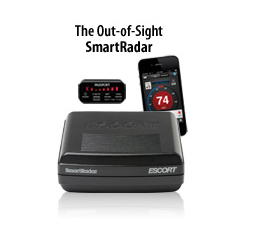
To this most distinguished list, we can now add the Escort SmartRadar windshield-mount Bluetooth integrated radar detector.   With its built-in Bluetooth capability, the Escort SmartRadar can directly communicate to a dedicated iPhone or Android-based smart phone application, called Escort Live!.  EscortLive! provides real-time speed trap and photo enforcement threats from both other Escort Live! users and their class leading Defender database.

Escort was kind enough to provide me an early production model of the SmartRadar slightly before its general introduction to the public to get my take on their latest high-tech detector. 

After driving with it for a good number of months and many thousands of miles, the Escort SmartRadar has become one of my very favorite of radar detectors.  And this is true even if I don’t operate it in conjunction with the accompanying EscortLive! application.

Appearance:

What I especially like about the SmartRadar is its packaging.  It does not look anything like a conventional radar detector on the windshield.  It has no built-in display, no buttons per se to control it, just a single nondescript power button on its side.  The dimensions approximate my EazyPass transponder.

Since the detector has no built-in display (although an external one that is included can be attached), it can be mounted very high up on the windshield (out of reach and out of mind) behind the rear view mirror making it nearly impossible to view from outside of the vehicle and making it essentially disappear from within.

Another advantage of extreme high-mounting is that the SmartRadar detector is less likely to overheat or ‘cook’ in the sun especially when your vehicle is parked as the mounting position tends to move it out of the way of the direct sunlight.  Just be careful to make sure that the SmartRadar detector has a clear line-of-sight below the “shade-band” across the top of the windshield as it can reduce the detector’s sensitivity.

One controls the operation of the SmartRadar with its accompanying smartphone application.  All operating characteristics of the detector are fully customizable.  And since the settings are permanently saved to the detector, I find the SmartRadar can be operated in what I call a headless mode–that is stand-alone–without its display and without running its smartphone application.  I have found that the audio qualities of the SmartRadar detector are so good that one doesn’t need to have to look at or even touch it, it does just fine on its own, out of sight and out of mind, until of course, you need it.

In fact that’s my preferred way of running it.  Any time I wish to make setting changes or get the extra protection of GPS protection and the crowdsourcing of EscortLive!, I can simply fire up the application to easily change the settings of SmartRadar.

Performance:

Like most of detectors from Escort (and Beltronics), the SmartRadar is based upon their venerable M4 platform, which provides exceptional reception performance to Ka-band police radar, excellent reception to K-band, and good reception to X-band (especially important to NJ and southern Ohio drivers).

I also found the SmartRadar police laser detection capabilities to be especially good.  In fact, I believe I was able to do the near impossible with this detector–avoid a police laser trap using only my wits and no other countermeasures, such as Veil or a laser jammer.

Some time ago, I was traveling with my wife to the NEK in Vermont on I-79.  I had taken a long and slow route across the state of New York and was running well behind in time, when I hit the freeway.   I needed to make up some serious time,  so I did.  My 5 series Bimmer was in the shop getting worked on, so I had a loaner 335i convertible.  The time was nearly 8pm and it was beginning to get dark.  I wasn’t sure if laser was in use, but I assumed it was–as most states do.  Knowing that I was especially vulnerable, having no countermeasures, I consciously thought of taking an evasive maneuver if I ever got hit with laser.  I had kept this in the fore-front of my mind.

Sure enough, nearly an hour later, the SmartRadar alerted to laser!  No other car was around me and I new I was traveling well above the posted limit.   I immediately took evasive action and quickly changed lanes while breaking rapidly!  Knowing that, in the evening, the preferred targeting spot of police laser is a headlight, I believed if I could rapidly change lanes, the officer would have to re-aim the gun, all the while giving me precious more milliseconds to slow down.

In my case, I was all alone and I knew it.  The SmartRadar continued to alert to laser as I scanned ahead to find my would-be predator and then I found him!  Tucked off the side of the highway, eclipsed by trees, a young officer was standing outside of his patrol car hand-holding what appeared to be an LTI police lidar gun.  As I passed him, I looked to see if he was running to his vehicle, for the eventual pursuit.  And you know what?  He did not!  He did look at me though as I passed him.

To be on the safe side, I kicked it up a notch and darted off the next exit just to be sure and to allow for things to cool/settle down a bit…like my brakes and my heart-rate!

I certainly don’t recommend that any one do this, because of the potential risks.

Instead, of course, I recommend driving with a laser countermeasure of Veil and a laser jammer (if one is allowed in your state), and relax knowing that you will have more time to safely slow down when targeted.

Three things, I believe, allowed me to successfully avoid getting seriously nailed:

  • 1) The presence of mind to be able to react at a moment’s notice
  • 2) The inexperience of a young officer hand-holding a police laser unit
  • 3) The operation of radar/laser detector adept at detecting and quickly alerting to police laser

While the M3-based (highest-end) detectors from Escort and Beltronics, still possess an absolute sensitivity edge, this little diminutive detector, especially when mounted high on the windshield, can oftentimes keep up with the big-boys, the Passport 9500ci, and Beltronics STiR+.

What the SmartRadar gives up in sensitivity to radar to these high-end remotes, it mostly gets back in mounting position, relative to the lower mounted high-end remotes.  It is not uncommon to find the SmartRadar out-alerting, if only by a little bit, its more powerful siblings because of its high mounting advantage.  Very impressive indeed.

Operation:

Here, the SmartRadar really shines.  The accompanying EscortLive! application takes the SmartRadar to a whole new level of performance.  Real-time sharing of traffic enforcement with other EscortLive! users and always up to date photo enforcement Escort Defender alerts, puts this detector in a class by itself.

If you find yourself slugging it out in urban areas where false alerts can punish you, beyond locking out those signals, the SmartRadar’s alerts can be tamed by selecting a mild chime alert.  Around town, that is my preference.  On the highway, though, I want to know the alert tone, so I immediately know what I am being targeted with, so I change the SmartRadar to alert with standard alert tones.

Improvements:

Features that I would like to see improved or added…

Audio alert ramp

The choppy and non-linear alerting style of the audio signal strength is still present.  This is something I first commented on years ago with the Escort Passport 9500i.  I simply don’t understand why this behavior has not been improved as it makes it harder to properly gauge the real proximity of the threat, an essential feature.  The Escort Passport 8500 X50 (black) still retains the silky ramp-up that every detector should have, so I see no reason why this behavior could not be addressed.

Battery consumption of EscortLive!

I find the EscortLive! app to be a real power hog, particularly with my iPhone.  If the iPhone is not plugged into the cigarette lighter, it will quickly run out of battery.  I even found that the iPhone appears to struggle somewhat in charging during operation of the EscortLive! application and the back even gets quite warm…meaning it’s burning some serious CPU cycles to operate.  I believe this is an area that needs to be improved as other “cloud-computing” applications, don’t appear to take nearly the same amount of power consumption to operate.  It will be interesting to see how the iPhone 5 and IOS 6 handle the app.

Truth be told, this is another reason, why I don’t run that app all of the time.  RadarActive, while not integrated into the detector as seamlessly as EscortLive!, is much easier on power consumption.

Further, and this I understand is a limit of the iPhone (and not Android-based smartphones), EscortLive! must be in the foreground to provide all of its capabilities.

I will delve deeper into the ins-and-outs of EscortLive! in a future article…

X-band reception

Unfortunately the trend with most detectors has been to de-emphasize X-band reception.  

I know false alerts are a pain and X-band alerts are nearly always false (unless of course you drive in the state of NJ or in another handful of states), but I still appreciate high-levels of sensitivity to it.   Will most drivers notice?  I suspect not.  In fact, X-band can be disabled in most parts of the US, as K, Ka, and laser rule the day.  Know your area and what forms of traffic enforcement are used.

Remember, a detector, no matter how good is only a tool to enhance your situational awareness, not replace it.

Customized Profiles

Not so much as an improvement, but as a novel feature request:

This is an idea that recently came to me, when my wife commented that she preferred certain settings to mine.  This, I believe, would be an entirely new feature that has yet to be seen in any detector.  And that is quickly selectable customized profiles that aggregate a series of setting changes.

For example, when I drive around town, I prefer the easy-on-the-ears chime to the standard alerts as well as reduced sensitivity to X-band, but on the highway, I definitely want standard alert tones and full-sensitivity so I know what I am being hit with (as early as possible)  so I know how to react accordingly.

Conslusion:

These quibbles aside, the new Escort SmartRadar is ground-breaking–a detector for the astute 21st century driver.

Highly recommended.

Online discussion: Escort SmartRadar Review by Veil Guy

Escort Passport 8500 X50 Black Review/Preview

Escort Passport 8500 X50 Black Review/Preview: The Newer, The Older (and that’s a good thing).

Updated: 23 Apr 14, By Veil Guy

New products, of late, have been coming fast and furious from both Escort (and its sister company Beltronics).

To maintain their respective product line-up’s “freshness,” some of their stalwart products have been getting a make-over, such as the Beltronics STi Driver whose recent replacement is the freshened Beltronics STi Magnum.

Now it’s Escort’s turn with their recently announced Escort Passport 8500 X50 Black.

Come to think of it, that’s getting to be quite a mouthful, especially when you consider that you can get the “Black” in two versions—one with a red display and the other with a blue display. This would mean their full product names would be the Escort Passport 8500 X50 Black Red and the Escort Passport 8500 X50 Black Blue, respectively. Woah!

Perhaps, the “black” reference could be dropped, in time, from the nomenclature as the “silver” models will be no longer. This is the only detector, that I am aware of, that derives part of its name from the color of its chassis. Or, perhaps could it be to suggest a high-performance version, a reference “borrowed” from Mercedes’ playbook with respect to their uber AMG Black editions. Or, perhaps, I have seen one too many Top Gear episodes and am over thinking this.

The long-established Escort Passport 8500 X50 series goes back a long time—spanning more than a decade of production when its life began as the original Escort Passport 8500. The 8500 was later updated with some claimed performance improvements and was rebadged as the Escort Passport 8500 X50.

The Escort Passport 8500 X50, itself, has spanned two underlying platform designs—originally starting with the S7 platform followed by the more recent M4 platform that appears in all Beltronics and Escort conventionally designed radar detectors.

The higher-end (and higher-priced) M3 platform is reserved for both companies’ “halo” products which possess the special capability of not being detectable by radar detector detectors while providing class-leading performance.

I have owned a good number of Passport 8500s over the years and while the newer (M4) models shared the same name as their earlier (S7) counterparts, these newer 8500s felt like different detectors, altogether.

In my opinion, some aspects improved and others, to be blunt, did not.

On the credits side of the ledger for the M4 versions, Ka-band reception noticeably improved over time. This is a good thing too, as most newer police radars that are being put into service operate on Ka. In the US, three frequencies are used—33.8Ghz, 34.7Ghz, and 35.5Ghz—of the very wide Ka band.

Another ” improvement,” I believe, was the replacement of the earlier models’ speaker setup with a much louder one and to nuance this attribute even further, although I appreciated the sheer loudness of the updated speaker design, I preferred the tonal characteristics of the older ones.

This speaker setup first made its appearance with the Escort Passport 9500i, itself being an M4 based detector.

Another good aspect of the M4 design is its stability in maintaining proper calibration. As wonderful as the S7s were, they were more prone to falling out of calibration due to their circuitry, requiring a return to the manufacturer to address. The M4s have proven quite a bit more “reliable” in the field.

On the debits side of the ledger for the M4 versions of the 8500 X50s, it appeared that with the pickup of Ka-band performance, relative to the earlier S7 versions, it came at the relative “expense” of both X-band and K-band reception performance (even if only slightly). While X-band remains seen in a more limited number of states, K-band is still widely used.

I have seen this approach (taken) across other models from a number of other radar detector manufacturers (namely Cobra and Whistler).

And to be clear, Escort’s M4 8500 X50s perform noticeably better on these two other frequencies (both relatively and on an absolute basis) than these other manufacturers’ designs.

Another detractor, for me, with the newer M4 versions of the 8500, was the less-than-stellar signal-ramp.

With the introduction of the M4-based 8500, gone were the silky smooth and linear alert ramps (audio “Geiger” tones) of the long-established S7s. In their place were “choppy,” non-linear, and far too aggressive alerting that made it more difficult to distinguish between instant-on or constant-on radar and nearly impossible to make an accurate threat assessment by gauging the actual distance to any given radar threat with such models.

I first noticed Escort’s revised alerting behavior on the Passport 9500i, followed by the Passport 9500ix and continuing through the non plus ultra Passport 9500ci remote on up to their top-of-the-line dashmount, the Escort Redline.

My general feeling has been that these newer radar detectors—that employ these far too aggressive signal ramps—are less refined than their earlier brethren.

So, it was with great pleasure when I observed this latest iteration of the Passport 8500 X50, to behave more like the earlier S7-platformed 8500 X50s did.

8500 X50 Black versus K-band source

I do believe this makes the 8500 X50 Black the first Escort model to finally reintroduce the silky alerting style** that has for too long been absent in their product lineup and I sincerely hope that this superior approach re-emerges across the entire line of Escort going forward.

(**Note: While the ramp is far more S7-like, there appears to be a somewhat “abrupt” drop-off at the tail end that feels like an un-natural squelch. IMO, still has a little room for improvement.)

8500 X50 Black versus two Ka-band sources

Appearance-wise, this new Escort sports a new convex lens cover over the radar receiver’s horn.

Whistler has long been employing convex lens designs, beginning in the early 1980s with their Spectrum and Q2000 dual-band X and K detectors—with the intent of improving reception performance to certain frequencies and/or attenuating unwanted ones—by bending and focusing select wavelengths of RF.

Escort and Beltronics eventually adopted a very similar lens design with the STi Driver introduced in 2006. I suspect, a percentage of any observable improved performance and/or false rejection to the X50 Black may, in part, be attributable to this design element.

Once I accumulate more real-world radar encounters, I will better be able to gauge the relative performance of the Black.

An M4 that feels more like an S7

In the meantime, I am heartened to see Escort return to its fundamentals—the building of radar detectors which provide solid performance while maintaining overall balance, refinement, and, yes, grace.

Beltronics STi Magnum Review/Preview: The Beltronics STi Driver Gets A Makeover

The Beltronics STi Magnum: Beltronics New Dashmount Top Dog Detector

Updated: 23 Apr 14, By Veil Guy

Before I delve into the particulars of the new Beltronics STi Magnum dash mount radar detector, I think it prudent to go over a brief history lesson with all y’all.

It was nearly six years ago, when Beltronics forever changed the landscape of the radar detector industry by inventing an extremely sensitive radar detector that was immune from detection by a specialized piece of electronics, called a radar detector detector. RDDs, as they are called, are used by traffic enforcement, to electronically sniff out radar detector usage in certain areas where their use is forbidden. Up until that time, the notion of such a detector was the stuff of legend, like that of Pegasus, the mythical flying horse.

The Beltronics STi Driver was a seminal product, not only because of its novel abilities, but also because it was the first dash mount radar detector ever sold by Beltronics or (its sister company) Escort that exceeded the price of Valentine One, which at $399USD, had been the long-time high-water mark in price (and performance).

Yes, the original Beltronics STi Driver was truly a breakout product and, truth be told, the mighty Valentine One, has been spending less and less time on my windshield ever since.

However, in the nearly six years since its original debut in North America, other (and more significant) detectors have come from both Beltronics and Escort, based upon the same M3-platforum, that have surpassed the performance capabilities, as great as they were, of the STi Driver: the supremely capable Beltronics STi-R remote, the impressive all-in-one high-end remote from Escort, the Passport 9500ci, Escort’s top-of-the-line dashmount, the Redline, and most recently, the all-time best detector ever, the Beltronics STiR Plus.

Each of these models, has shown a steady, if not subtle, performance improvement over the life of the M3—leaving the original STi Driver, how should I say, somewhat long-in-the-tooth.

There has been a nagging and persistent suggestion by a few online forum members that the original STi Driver’s performance was “neutered” a bit, by design, at the outset (allegedly sourced from someone with intimate knowledge of its engineering).

So, as impressive as it was, at the time, these same folks have been under the long-felt belief that there was more performance capability that could have (should have) been unleashed. Whether or not this was actually the case, or whether the engineering team simply found ways over time to improve on the original design & materials, or both, really isn’t important, in my opinion, because these sorts of dynamics are the same in many, if not all, manufacturing, whether it be of computer CPUs, cell phones, or automotive engine designs.

What is important, is that both Beltronics and Escort have continued to offer evolutionary performance improvements and increased value to the consumer, with each subsequent introduction of their high-end products; something that in any event, I find incredible, given the astounding levels of performance that had already been achieved with each of their earlier models.

Beltronics STi Magnum versus two 34.7 Ghz Ka sources

The brings us to the STi Driver’s replacement, the STi Magnum. The product has been described to me as an “opened-up” Driver. Something along the lines of the Escort Redline, except from Beltronics.

According to Beltronics’ press release, the STi Magnum provides a 60% greater improvement over its predecessor, the STi Driver. Technically, this would amount to approximately 4dBs in sensitivity improvement and, on its surface, would effectively eliminate the performance “deficit” between Beltronics’ high-end dashmount and Escort’s that could be observable in certain speed radar encounters.

But, knowing the wizards at Beltronics, the new Magnum, could prove to be more than simply their version of the Redline. For starters, I would expect a far more useful signal strength ramp, something that we saw in the new STiR Plus remote (the signal ramp design of the Redline has long-tempered my enthusiasm for it). Nor, would it surprise me to see a bit better overall balance of performance/refinement out of the STi Magnum than the Escort Redline (just as I tended to prefer the earlier S7-based Beltronics RX65 (video) to the Escort 8500 X50 (video), detectors of similar design).

The STi Magnum is priced at $469, which is the same price point as the outgoing STi Driver.

What ever the STi Magnum proves to be in the real-world of driving, it is a most welcomed update to what I regard as one of the most significant dash-mount radar detectors ever produced (and one of my favorites). I am really looking forward to accumulating some serious miles on this new top-of-line model from Beltronics. I will share my real-world experiences in an in-depth review, in the near future.

Stay tuned!

Online Discussion: STi Magnum Preview

Beltronics STi-R Plus Review Part II: The Greatest Radar Detector of All Time

Updated: 23 Apr 14, By Veil Guy

This review is the easiest review I have ever performed and is the follow-on to my initial review of the Beltronics STiR Plus published back in March of this year.

In fact, for those that would prefer the Cliff Notes version, I will save you some time by making this review extremely terse:
The Beltronics STi-R Plus remote radar detector is by far the greatest radar detector of all time. If you are fortunate enough to be able to afford one, by all means, acquire one and marvel at its performance, as there is nothing else (remotely) like it on the planet. It is as close to perfection as anything I have ever driven with. Currently, the Beltronics STiR Plus has no equal and sits at the top of the radar detector food-chain.

For those interested in reading a bit more…

Shortly after I received the first Beltronics STi-R Plus remote radar detector for review, my Bimmer developed a timing chain guide failure (having nearly 210k miles accumulated), so my ability to really put it through its paces was delayed by several weeks. After the $3200 repair (ouch) I was finally able to do so.

Fortuitously, I had to make a business trip to Louisville, Kentucky during the week of the Kentucky Derby (I have some connection to the horse racing industry) and I had two options to get there and back, one by air (Southwest is my preferred airline) and the second by land.

Early morning breeze on the home-stretch before the Run for the Roses

Of course, I chose the second option, as it would allow me to put two other Thoroughbreds through their paces—one from Munich, Germany and one from West Chester, Ohio. I created a route that would allow me to accumulate 2600 miles round-trip and take me through nine states and the District of Columbia, never mind the price of a gallon of petrol.

To be thorough, I also took with me two Beltronics STi Drivers, two Escort Redlines, one Escort Passport 9500ci, and the previous Beltronics STi-R—all M3 platform radar detectors. By examining the performance of each of these detectors with real-world encounters, I was hoping to plainly observe and better understand the evolution and refinements of the M3s since the original STi Driver was introduced to the North American marketplace nearly six years ago.

As I have written on many occasions, what separates the Beltronics STiR Plus (and its predecessor the STiR) from all of the other M3-designed radar detectors is their ability to be performance-tweaked using Ka band-segmentation and reduced filter processing. The result of these two tweaks is a radar detector that distances itself (sometimes by a considerable margin) to all others and I do mean all.

I believe both Beltronics and Escort have continued to improve upon the performance of the M3 platform over the years and it appears to me that my Beltronics STiR Plus is effectively more sensitive to my previous STiR (what I considered the high water mark prior to the Plus) by an addtional couple of dBs as it was not uncommon to observe the STiR Plus out alerting the STiR by a number of additional seconds, an impressive feat.

Instant On X-band Encounter in Athens Ohio

The Beltronics STiR Plus has incorporated all of the great attributes of the Escort Passport 9500ci, including GPS and photo-enforcement capability, RDD immunity, ability to mate to their ZR4 Laser Shifter, user upgradeability via a USB connection, while providing a superior audio/visual signal alert ramp. This last attribute is something that I (and a host of others online) have been calling for, for a looooong-time and I am pleased to see that the Beltronics engineering team has finally listened. The Beltronics STiR Plus now properly alerts to impending threats in a manner that encourages safe reactions to well-gauged distances to actual threats. With a detector of such high sensitivity and quickness, it is essential that its performance be accompanied by an equally high quality signal alert and the STiR Plus delivers in spades.

Constant On 33.8Ghz Ka in West Virginia

I have never felt more comfortable driving enthusiastically than when I am driving with the STiR Plus. Detection performance to all radar bands appears to have no equal (although the original Beltronics STiR is a really close second). And has been the case for some time from both Escort and Beltronics, detection of the heavily used 35.5Ghz Ka appears most impressive.

Constant on 35.5Ghz Ka in West Virginia

With respect to photo enforcement, the STiR Plus utilizes a vectored approach to these sorts of threats. When driving in Washington D.C., I noticed that when known photo enforcement that deployed radar, the STiR Plus would indicate the threat while at the same time auto-muting the radar detection alert. This is a really nice and subtle touch. It is interesting see that when traveling eastbound on Route 50 and passing a radar-based speed camera facing the westbound lanes, the STiR Plus did not alert to either K-band radar or the presence of the camera, as it was not a threat when traveling in an easterly direction, but it did alert to it when traveling in the westbound direction, when it was a threat. Very sophisticated stuff going on here folks, to be sure, and all being handled very nicely by the STiR Plus.

I did encounter an instance where such a design could present a challenge and that was with a K-band radar-based speed camera position on I-395 just South of the tunnel below Route 50.

D.C. Camera Photo Enforcement

In this particular instance you are vulnerable as the GPS portion of the detector looses its signal with the satellites while you are under cover of the tunnel with no direct line of site to the satellites and doesn’t quite have enough time to reacquire the GPS signal once you emerge from the tunnel to alert to the threat before it is too late. Fortunately for me, my older 9500ci (which does not have the most recent firmware loaded) managed to alert to the K-band radar that was used. Even though this particular encounter is extremely rare, it is important to be aware of it. In the final analysis, no matter how good technology gets, there is no replacement for old-fashioned driver situational awareness (a fancy way of saying, pay attention to your surroundings).

As expected, the Defender photo-enforcement database remains the class-leading photo enforcement database, although the STiR did fail to alert to two K-band photo-enforcement cameras on some secondary roads in rural Maryland, one ominously placed immediately after a 10 mile per hour speed drop that lasted for barely longer the capture range of the radar. Fortunately, in both cases, the detector alerted to the K-band radar being used. Even so, situational awareness can save the day in those rare instances, when your detector may not.

Laser detection filtering also appears to be improved, with a noticeably fewer amount of false-alerting to laser-based lane-departure systems used in a number of passenger vehicles.

When the original Beltronics STiR was taken off of the market, I was very disappointed, because I regarded that model (and still do, for that matter) as a seminal product. I am thrilled that the powers that be at Escort and Beltronics have allowed for the re-introduction of the Beltronics STiR in an even more impressive package.

My conclusion to this review can be found at the beginning, no need to repeat it. But I must pass on congratulations to the engineering team. You’ve accomplished something really incredible here, and I can only imagine what you folks will do for an encore. As I see it, I really am hard pressed to imagine how they could improve upon its sheer radar detection performance. I expect additional capabilities will appear instead (like crowdsourcing).

I can only hope that management will offer the same capabilities in a dash-mount radar detector, again something that I have been calling for, for quite some time, but as Hal Holbrook’s character (Lou Mannheim) said in the movie Wall Street: That’s how IBM and Hilton were built. Good things, sometimes, take time…
Hopefully I won’t have to wait too much longer. Imagine the ability of carrying the power of the STiR Plus in the palm of your hand. Woah!

Happy and safe motoring.
Please show your support of the online vendor(s), who support my blog:

Distance and Signal Strength RD Tests: A Case of the Tail Wagging the Dog?

Updated: 23 Apr 14, By Veil Guy

Distance and Signal Strength RD Tests: A Case of the Tail Wagging the Dog?

I have been meaning to publish an article on this subject for more than a few years and had been sitting on putting on the finishing touches to this one, that is until I came across a posted comment online this evening.

The forum member had just read the latest annual test to come out from a long-established RD testing website and incorrectly interpreted their results, further reinforcing my concerns about performance comparison test reviews that are and have been presented in a fashion as to confuse the ordinary consumer as to how different radar detectors perform relative to each other.

As a result of that post, I decided it was high-time to dust of this article, apply some finishing touches, and publish it. (I also want to note here that it is not my intention to offend anyone in the following article, but I do believe the story needs to be told, for the benefit of BOTH the manufacturers and the consumers of radar detectors.)

So here we go…

Straight Talking Radar Detector Comparison Tests: Distance vs Signal Strength vs Sensitivity

When I think back to the early passive radar detectors of the 70’s, the biggest issue besides their lack of sensitivity was their lack of ability to provide signal strength feedback to allow the driver to accurately access the sense of urgency: Should I let off the gas pedal and apply a light touch to the brake pedal, or do I need to stand on the brakes immediately?

Many early radar detector adopters were truck drivers and the most common tool for a truck driver was his/or her CB radio. I guess it came as no surprise when Escort introduced their first super-heterodyne model that it shared something in common with the CB radio. They both employed a strength meter that truckers had become dependent on over the years, because beyond the importance of alerting you to an approaching radar threat, a radar detector must also convey an accurate sense of urgency to same.

When the threat is sufficiently far enough away, a radar detector should alert with a level of urgency that informs the driver that while there is a threat ahead, he or she has enough time to react appropriately and safely (ie; gradually) in the event any speed “corrections” need to be made.

On the other hand, if the threat is eminent, the driver must be informed by the detector that attention must be swiftly directed.

When the approaching threat is somewhere between these two extremes, the detector should indicate this as well with a varying degree of urgency.

In each of the three conditions cited above, a radar detector which conveys this sort of information through its alerting mechanism accurately and gradually is said to provide a good (smooth) signal ramp. A radar detector that does not, provides a poor signal ramp and is far less desirable.

But, something happened to one of my favorite brand of detectors. Their silky smooth ramp-up (of nearly 30 years) gave away to a ramp-up that, shall we say, was less than desirable. I noticed this and commented on this phenomenon when I reviewed an early Escort Passport 9500i (Escort’s first GPS-enabled dashmount). My hope and expectation was that the observed behavior was a result of an early production “glitch” (for lack of a better word).

Unfortunately, this did not turn out to be the case as subsequent models exhibited similar aggressive signal ramps (this included newer revisions/versions of older/existing detectors, as well). An aggressive signal ramp occurs when a radar detector alerts to a weak signal, but conveys an urgent Geiger rate. When an aggressive signal ramp is combined with a very sensitive radar detector, one ends up with a near full strength alert for miles depending on terrain and well before one’s speed could even be clocked with police radar.

The opposite of an aggressive ramp is one that provides a low warning for the majority on an encounter only to ramp up at the very tail end after you’ve been well inside the “red zone.” Cobra radar detectors, tend to act in this manner (as their dynamic range is far too broad).

My preference is a ramp up that is somewhere in between. Maybe I was read the story of Goldilocks and the Three Bears one too many times as a child, but it seems to be there may be a lesson within the story. I have repeatedly commented on my observations in both written and video forms and is something that I still continue to hope that this recent trend in overly aggressive signal ramp will be addressed to be more along the lines of some recent models released by Beltronics (such as the all-time best, Beltronics STi-R Plus) and the pre-M4 platformed models (S7) of Escort.

For years now I have asked myself why would such an approach to signal ramp-ups and ramp-downs be forgone to something that is far less useful in information conveyance. I had not been able to come up with any possible answers until recently when I was reviewing historical test results from a long standing RD test site.

The year was 2005. It was a particular radar detector test that caught my eye and started the wheels turning in my mind. The test for the first time (and the ones that followed in subsequent years, to this very day) showed detection test results, not just in distance, but accompanied with signal strength indicated for each with an outright suggestion that those reporting at higher signal strengths than others were more sensitive than those that reported at lower signal strengths.

Having read this year’s published test results and the ones that followed, I believe there were implications, in these reports/reviews, that any given radar detector that alerted with a higher signal strength level (as a percentage of its maximum) demonstrated a higher level of sensitivity than one that was also alerting, but with a lower level of urgency.

To the untrained eye or uneducated consumer, such an implication may sound plausible on the surface, but it is completely untrue.

While it is conceivable that any two identically designed models that alerted in a manner where one was consistently higher in signal strength than the other at any given distance, would indicate that the one alerting at a higher alert signal could properly be viewed as being more sensitive, but making such comparisons or drawing such conclusions across different brands or even more so across different manufacturers would be egregiously false as there is no standard to which everyone adheres to.

To be candid, I fell prey to the same faulty conclusion when I road-tested one of the first Escort Passport 9500cis, when I came across a radar trap that was quite a distance away. The ci alerted at nearly full- strength. It was so startling, that I slammed on my brakes, thinking that I was within speed-clocking range (typically less than 2000 feet). When I realized, instead, that he was quite a bit farther away than that, my initial impression was that “wow, what a sensitive detector to be alerting a full-strength from such a great distance.” Even with all of my years of driving with radar detectors, I was duped as well. So I fully understand and empathize with those who come to the same faulty conclusions.

So, why would such a test be orchestrated and results be reported in such a manner?

Well, I thought about this too and I am putting forth the following speculation.

Over the many years of detector manufacturing (three decades plus and counting), the separation in performance, to constant-on (continuously firing) radar, between radar detectors as evidenced on certain staged test courses (ie; extreme long-distance) has compressed significantly, as detectors in general have improved considerably. To render such a test as less meaningful/relevant.

There was a time not so long ago that such a test could clearly demonstrate the superiority of one brand verses another. But as time has marched on and improvements have been made across all models from all manufacturers, such a test no longer clearly demonstrated the big differences that still exist, but do not become apparent in such tests.

Such long-distance test courses have been extended from 9+ miles and beyond**, to the point that the curvature of the earth comes into play and presents itself as the limiting feature. The problem becomes then if all or most of the detectors are alerting at these extreme distances in this remote section of the United States how can any distinctions be made for the reader to determine which ones are best?

Enter the signal strength level and the myth that higher signal strengths indicated at any given distance equate to higher sensitivity and performance levels.

Since readers (and especially manufacturers) expect winners and losers in any “test,” what better and easier way to do this than by adding a seemingly important additional indicator?

The problem is, the logic is faulty as are the conclusions made from such a test.

Going back to the beginning of this article, an essential feature to a radar detector is the ability to accurately convey to its owner the level of any threat in real-time. A detector which alerts either too early or too late with its maximum alert is doing the driver a complete disservice as most every alert will either feel immediate and never immediate enough, respectively.

While I absolutely appreciate the sheer sensitivity and performance of the current Escort line of detectors (such as the 9500ci mentioned earlier or the dashmount Redline), it is their too aggressive signal-ramp that has me personally favoring the Beltronics camp (and their brilliant STi-R Plus with its far more useful signal ramp) and appreciating, even more so, other (less sensitive) detectors which have stayed true to accurate signal-strength reporting, such as the Valentine One, some Whistler models, and earlier model versions (S7 Platform) Escort’s and Beltronics’ dashmounts.

Perhaps it is merely an unfortunate coincidence, but detectors incorporating far too aggressive/non-linear signal ramps, while appearing “good” to some (uninformed) on paper in tabulated form, in reality provide little or no utility in conveying situational awareness accurately.

To be clear, I am not suggesting (and I don’t have any knowledge) that there is a direct connection between any given manufacturers chosen signal ramp and such tests nor am I specifically condemning any specific reviewer’s testing methods—as I fully appreciate the time, expense, and effort to conduct them—it is simply my assertion that reviewers as a whole (professional or amateur) should not place emphasis on signal strength and try to tie it to the appearance of improved sensitivity in such a manner as to encourage manufacturers to deviate from sound design approaches just for the sake of appearing especially good on such a test which, in the final analysis, serves little purpose other than to show some arbitrary group of “winners and losers” and has no basis in reality.

Happy and safe motoring.

** Footnote: Anyone who has driven with a radar detector out West in the remote desert or on a long flat-bridge (like those of the Florida Keys or the Chesapeake Bay-Bridge Tunnel) and encountered a radar signal, can tell you (as I will) that many multi-mile alerts to radar are not only useless, they are annoying as hell. And the reality, despite claims to the contrary by some testing sites, extreme distance detection capability (to constant-on radar) doesn’t translate in many cases into extreme alerting differences in the real-world of every day driving encounters and detection distances are generally far far far less than what would otherwise be suggested by such tests, with the very same detectors. There are many other attributes of detector performance (including environmental) that are just as important, if not even more so.